Saturday, May 7, 2016

Let's Talk Terraforming

If it should happen one day that our planet is in danger or if its capacity for inhabitants has been reached, then what do we do? From the early tribes to the biggest civilizations, we have always been closer to microorganisms than to animals when it came to the speed at which we colonized and occupied the Earth. And what about meteorites? One day, a rock as big as the one that is believed to have been responsible for the extinction of the dinosaurs might knock at Earth's door once more. Then what? Will we have what it takes to destroy or deflect it?

Questions like these don't have clear answers. And that's why they're important. The only way we can keep having a safe population expansion is if we spread outwards. Sadly, all planets around us are not Earth-like; and the closest Earth-like planet is light-years away. But we can change that. Get ready for something straight out of a fiction novel. We have tools we can use to terraform planets to make them more habitable (like having a decent atmosphere and oxygen). Although it is imperative that we start terraforming planets as soon as we can send humans there, the process is long and costly.


So obviously Mars is a great start since it resembles our planet the most. Here is what has been proposed until now. We can start by releasing greenhouse gases (like chlorofluorocarbons) in the atmosphere. By giving Mars its own atmosphere, we allow the sun's rays to get trapped and heat up the planet. The temperature increase will release the CO2 that is trapped in the polar caps and contribute even more to the growing atmosphere. This cycle keeps going until the entire poles have released all their CO2 and the temperature will be sufficiently high to melt the ice and provide water. Finally, planting trees will provide the planet with the oxygen needed to sustain life.

So in summary: create atmosphere, raise temperature, release water, CO2 and oxygen and you got a planet where you can live on without a space suit. But this will happen over centuries and since this sort of investment doesn't bring anything in the short term, my guess is that we are far away from actually seeing such a project take place. Of course, the time taken to terraform a planet is proportional to how different that planet is from Earth. Let's consider the Moon as our next potential candidate for terraforming.

Since the moon doesn't have trapped CO2 in its poles (or an easy access to any other ingredient for life), the best way of terraforming it would be to capture comets that contain ice and other constituents and crash it on our satellite. Sadly, this is not something that's as easy as it sounds. Even if the moon is closer to us than Mars, it is also a lot smaller. It would be a good stepping stone for more ambitious missions though, and a good place to start.
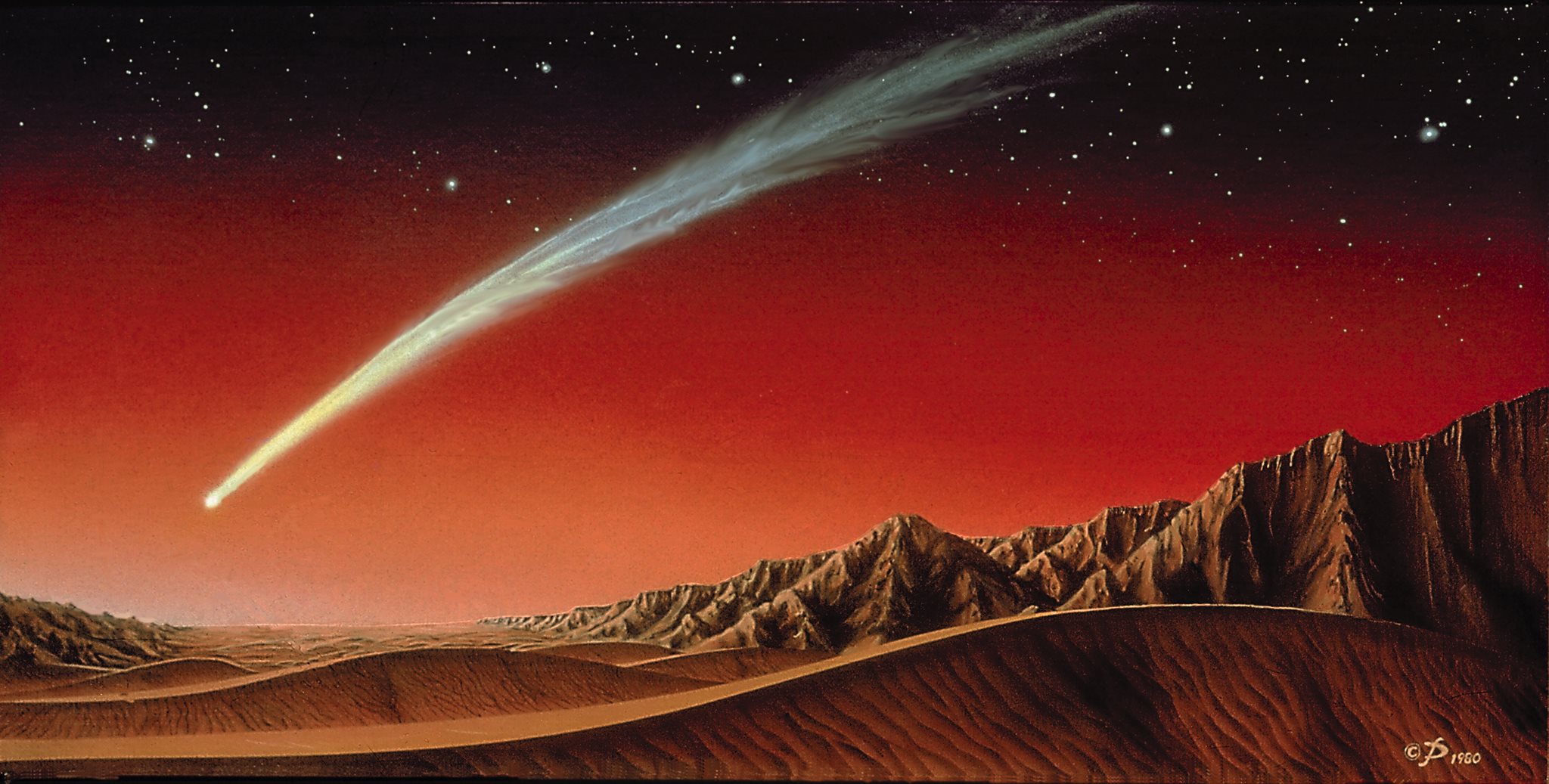

Mars and the Moon would therefore be a good place to start terraforming. The moon should be used as more of a playground and experimental project in that domain, whereas Mars could be the Earth 2 in a couple of centuries. With the discovery of new technologies and with, hopefully, an increase in the funds given to NASA, we can (and probably will) begin our colonization and terraforming process of new planets and maybe even new solar systems. It is captivating what humanity can do as a whole and terraforming will be a major step in discovering not only new frontiers, but also what Man can achieve.

For a bit more drops of future, visit:

Friday, March 11, 2016

The Race to Mars


Shortly after Sputnik 1 was launched in 1957 by the Soviet, NASA was born under Eisenhower. As an aerospace agency, it was mainly in charge of the american space exploration. That being said, the real suspected cause of the existence of such an agency was to race the Russians to the moon. NASA had at its disposal US$89 million; an incredibly large sum of money that would keep on growing to represent, at its peak, 4.41% of the federal budget. This is a surprising investment considering that, except the numerous technological advancements it brought to our society, it did not directly benefit the american society. Going to the Moon did not really solve any problems on Earth. But it was a fantastic achievement. One that would pave the road for further space exploration missions and research. 

The important point in this is that the race to the moon was a political cock fight. But it served as an effective way to develop and advance scientific discovery in aerospace and many other fields. Of course, after the moon landing, after the race was won, NASA's budget (in % of the federal budget) decreased almost every year. Without this need for a political battle; without being provoked into investing in a battle or a race, research in space exploration was not prioritized over other "more urgent" problems...until today.

I have described the stakes of going to Mars in the previous post. When NASA reached the Moon, it had political support from all sides. Now that that's over, even if a mission to Mars is a great idea, problems are solved faster with a good financial support. As you know, it would take a regular ship 18 months to make the one-way trip to Mars. The primary problem with getting to Mars is propulsion. Making the trip last 45 days would solve problems such as radiation exposure, food, bone loss and boredom. But it's impossible. Or is it?

The national corporation Rosatom from Russia said that they are working on a nuclear engine for a rocket that could reach Mars in around a month and a half. Most of the problems for this type of propulsion system have been solved by 1967 when they were launching fission-powered satellites. Thrust will be produced by burning a chemical with the heat generated from the splitting of atoms. Why are the United-States not considering the same alternative? Maybe because nuclear incidents are disastrous (think about Chernobyl)? What would happen if this ship blew up during take-off? These questions led to a lot of policies surrounding nuclear power in the states.


Of course, is all of this possible? It might be too good to be true. The corporation has set 2025 as the due-date for a potential prototype. The only problem so far seems to be the budget of Rosatom. They were given about $700 million for the entire thing. That's 4% of NASA's budget for 2015. And remember, they have 10 years to build the thing with only that amount of money. Is it possible? Hopefully it is. All I know is, it will be a step forward towards getting to Mars.

That being said, this news might make the american government invest a lot more in NASA and in other space exploration programs. Like for the race to the Moon, maybe conflict will create great possibilities for scientific advancements. Are we at the starting line of
another historical race? Let's wait and see. The next ten years might be incredibly interesting for global space exploration as we move closer to putting a person on Mars.

For a bit more drops of future, check out:


Monday, January 11, 2016

Our Trip to The Red Planet


"There have been 43 unmanned mission to Mars until this day.  
21 have failed."

The next four new posts that I will write will have something a bit different about them. They will all revolve around the same idea: the future of mankind in our Solar System and how that can, should and probably will be achieved. Consequently, all of these four posts will be intertwined and will form a sort of Tetralogy. The idea behind all this is that writing individual posts on different subjects is nice, but tying them together gives each subject so much more weight. It shows why such advancements are, in concrete terms, important not just for now, but also for future humanity advancements. Without further ado, let's get to it.

Our journey starts in 1944, when the Gestapo arrested a man in Germany and charged him since he was proposing to build interplanetary spacecrafts instead of military weapons. After the end of the war, that same man worked for the United States on ballistic missiles; a program that NASA later assimilated. NASA went on to calling him the "greatest rocket scientist in history" after his contribution to the boosters that propelled the Apollo Mission. Wernher von Braun was always a fervent supporter of a human mission to Mars during his lifetime. He even wrote a non-fictional book on how to do it. Even with his numerous pleadings, a trip to Mars didn't seem any closer.

And why is that? How hard could it be? Very Hard. And very costly. The total cost of a 20-year program that puts a man on Mars is between 80 to 100 B$. Getting there is also a big problem. Mars and Earth are at their closest every two years. This leaves a small gap called "striking distance" when the spacecraft is able to travel back to Earth (Think of it as timing a jump from one moving car to another). This puts the duration of a trip to 2.5 years using today's chemically propelled spaceships (they take about 6 months to get to Mars).


2.5 Years, 913 days of mission. It might not seem long for us, but our brains are wired to enjoy diversity. There is no diversity in a small capsule, in the emptiness of space, in talking with the same people for 2.5 years. Psychologically, a trip to Mars is horrible. Boredom, isolation and repetitive tasks will haunt each crew member on that trip. Oh, and they also have to deal with radiation, loss of bone mass and landing on a planet that actually has a noticeable gravity (about 2.3 times the Moon's). Gravity is not the only thing complicating the landing; since there is almost no atmosphere on Mars, there isn't enough friction to slow the entering spacecraft. Therefore, the module will have to minimize the radiation, the time taken to Mars and maximize space for the crew, storage for food and air, things to do to not get depressed and the drag it produces when entering the atmosphere on Mars (and recycle used water).

At this moment, you might wonder why we should do it. Why spend billions on the technology to go to a distant planet and back? Did we get anything back from going to the Moon? The Moon and Mars are two milestones on our way to space exploration. If we are to colonize other planets, then our first best bet would be Mars. It's the most similar planet to ours in our solar system. Developing the technologies to overcome the challenges Mars throws at us is just a step in the right direction. Earth changes faster than we can adapt. The increase in population is also a big problem And if we are to survive as a species, we must look for new inhabitable worlds. And one way to do that is by colonizing other planets. As men created colonies in the past to spread theirs lands, we can do the same thing with planets. Space is also a very profitable venture. Trips to space, future technologies and asteroid mining are only a couple of things that could make space exploration worthwhile. Only problem is: we need to develop some pretty important technologies. Technologies that are as important on Earth as they will be in space. And those are the subjects of my next 4 posts.

For a bit more drops of future, visit:

Sunday, December 27, 2015

The Income-ing Revolution

In the earlier days of this blog, I have written an article that talks about how robots will become way more cost efficient than humans in the future. A question that might come to mind after reading that sentence is: How will we generate revenue in the future if more and more jobs are being automated? One of the solutions that seems to really stand out these days is called Basic Income. 


Similar ideas have been discussed as early as 1795, but the basic income, as it is presented today, only appeared during the 60s when a negative income tax was suggested to simplify welfare and help people get back into the workforce. Today, it is possible that a universal basic income might be the solution to the job loss problem. This income gives the same amount of money (equal to the calculated amount needed for survival) to everyone without conditions or discrimination. 

Why is this a good idea? Since the 1970's, wages have declined or stayed the same, jobs have become scarce and many people require public assistance to top off what they already earn each month. And the future, thanks to robots, does not look brighter. Finally, welfare is not as useful and efficient anymore as it was in the 90s (in America at least). Basic Income creates a floor revenue on which people can build, develop personally and enjoy life without fear of complete loss of income. Finally, it also helps us embrace change in the society (such as automation) without fearing its consequences on human jobs.

Why is it not a good idea? Well, it has not yet been proven to work on a big scale. Basic Income might cut welfare payments, reduce health care and tax credits to avoid raising taxes too much. But even then, basic income could only be affordable with around 45% taxes (2012 estimate from Ireland). There were trials in the 70s in the US that concluded that a basic income reduced poverty but also reduced the number of hours each person worked. So will it make people lazier?


Testing has taken place in Sweden, India, Germany, America, etc. The results are not unanimously positive, but in some places, basic income has generated some pretty good results. Crime rates have gone down, high school completion rates have gone up, but is this something that will be maintained in the long run? Wouldn't people try to abuse of this system or use the money for alcohol or drugs? There is still much testing to do and, if this idea is implemented, it will drastically change things on economic, politic and social levels. 

We are approaching an era where there will simply be less things to do. Maybe one day we will have to implement such a system. Let's hope that, until then, we would have understand the advantages and the consequences of such a drastic change to our society. This might be a solution that seems to solve no problem but it will definitely change the way we live our lives for the better or for the worst. Since both sides of the political distribution (left and right) seem to like the idea, why not give it a try on a bigger level and see what happens. It might even teach us something about ourselves.

P.S. I want to know what people from different places think of this. If you feel like sharing your opinion, go ahead and leave a comment. I'll read it with great pleasure!


For a bit more drops of future, visit:


Thursday, November 19, 2015

The Unconventional Way to the Top

I've been wanting to write about this subject for a while now since it has got a lot of media attention in the past few months. Let's go back a few years to the start-up region often called Silicon Valley. In 2009, an idea hatched inside the head of two entrepreneurs that would make a ton of noise and cause a lot of trouble. Uber was born. And two years later, the company went from operating from the coast of California to New York City. Today, calling a Uber car takes 2x less waiting time than the median response time for an ambulance. Sounds good? Well, let's take a look at all the commotion this application has caused.

If you've heard of Uber before, you probably did not only hear good things about it. Uber is what I like to call an aggressively competitive company. It's main role is to promote commuting by cars where the driver actually gets paid. This encourages people to use the app since it is easier and simpler than paying for an actual taxi (the passenger is charged directly on his credit card via the application). Obviously, the success of Uber has been making taxi drivers mad since their industry now make much less money. A lot of taxi companies have protested against Uber. Cities have tried to label it as illegal and have pressed charges. But still, Uber holds its grounds. How come?


To become a Uber Driver, you don't really need to do much. You need a 4 inspected door car, a good record, a permit and... That's it? Oh, and you also need to sign up on the app itself. How easy was that? Taxi drivers actually have to get trained before doing their job. Uber skips all that. This is why, in New-York City for example, Uber has a lot more cars than there are taxis. The towns have been imposing a tax on all the driver's profits, but that has not stopped the company from greatly expanding all over the world and acquiring profits of more than 50 Billion $.

Uber has been brought to court over the problem that its drivers are actually employees and not independent contractors. If the latter case was proven correct, employees of Uber would be subject to new rules. Uber has only been criticized for its aggressive ways in dealing with the competition. Its employees have acted as fake pedestrians, scheduling and cancelling rides from a competitor. Furthermore, Uber aims to make taxis obsolete. The industries have been trying to modernize their approach but customers always seem to prefer Uber. It has become a modern part of our lives even if its services remain  controversial.


Moreover, Uber seems to be wanting to play in the automated car industry. When Tesla announced it will be selling autonomous cars by 2020, Uber proposed to buy half of million of them. Such an impressive amount brings questions to mind. Why? What would Uber do with all of those cars? Of course, replacing existing taxi drivers seems to be part of the answer. Safety might be the other part. Such an investment might make Uber the owner of the most autonomous cars in the world. This shows how much power Uber has and how much it can still achieve in the business.

That being said, the problems Uber has had in past have been playing in its favor the whole time. Even if no one is sure if the service is within the boundaries of the laws, it has not stopped millions of people from using the service. This proves that sometimes, a bad reputation can greatly work in favor of companies. If Uber had kept things less controversial, it surely would not have become the company we know today. Even if a review is bad, it's a review. And the more people talk about it, the more Uber gets known. I wouldn't agree with their methods, but it is stunning how fast they revolutionized an old, firmly established industry in so little time. For that, I think they deserve the success they have today. Would I use their services? I do still prefer buses; but, out of curiosity, maybe once.

For a bit more drops of future, visit: